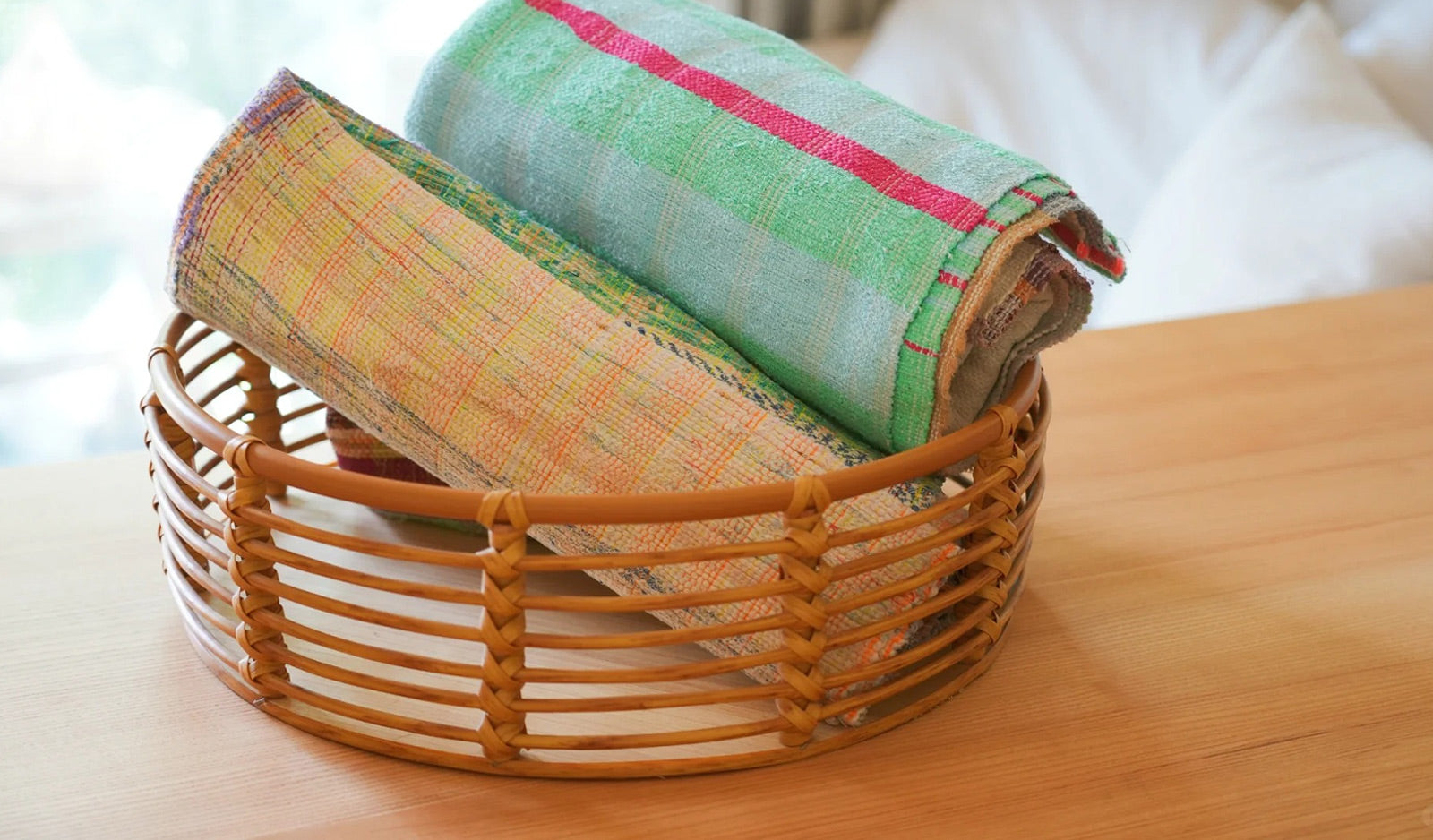
Sakiori is a weaving tradition that has been practiced in the Dai villages of Dehong for generations. The word itself means “to weave from old fabric.”
How It Works
Instead of using new yarn, Sakiori begins with fabric that has already lived. Old sarongs, worn cotton shirts, grandmother’s headscarves—these are saved, washed, and carefully torn into strips. These strips become the weft, the threads that cross over and under the warp, creating a new piece of cloth.
The process is slow. A single piece of Sakiori can take ten days or more to weave. The weaver feeds each strip through the loom, one by one, pressing it into place with a wooden beater. There is no machine that can replicate this rhythm. There is no shortcut.
Why It Matters
Sakiori is sustainability woven into cloth. It wastes nothing. Every scrap of old fabric finds a second life. In a world where fast fashion discards millions of tons of textiles each year, Sakiori offers a different way: use what exists. Make it last. Let nothing go to waste.
But Sakiori is more than an eco-friendly craft. It is also a way of carrying memory. When a weaver uses a piece of her mother’s sarong or her grandmother’s headscarf, that cloth carries something forward. The new piece is not just fabric. It is a continuation.
A Craft Disappearing
Sakiori is ancient, but it is also fragile. Fewer young women are learning to weave. The knowledge of how to prepare old fabric, how to set the loom, how to feel the rhythm of the shuttle—it is fading.
Suepla exists to give this craft a reason to continue. We purchase Sakiori cloth directly from the weavers of Dehong, paying a fair premium that honors their time and skill. We then work with urban artisans to transform the cloth into bags, home goods, and things to wear—pieces that can be carried into daily life, not hidden away in cupboards.
Cloth That Lives Twice
Every piece of Sakiori cloth has a history. The blue might come from a sarong worn by a mother. The brown might be from a tree-bark dye that has been used for centuries. The texture tells you that this cloth was made by hand, one shuttle at a time.
When you carry a Suepla bag, you carry more than a bag. You carry a piece of that history. You carry a craft that was almost lost. And you carry a promise: that this cloth will live again.
Logo list
Subscribe
Sign up to get the latest on sales, new releases and more …